
Tel: 403.259.0005
Tel: 403.259.0005
The Alberta Guide to Heavy Equipment Acquisition
Buying or renting heavy equipment in Alberta isn’t like ordering something off a shelf. There’s real money on the line, real deadlines attached to real projects, and if you end up with the wrong machine or the wrong dealer, you feel it fast. A dozer that goes down mid-job doesn’t just cost you a repair bill; it costs you crew hours, contract timelines, and sometimes client relationships you spent years building.
Alberta’s construction and resource sectors move fast, and the equipment decisions you make either keep you ahead of that pace or put you behind it. Whether you’re a contractor looking to grow your fleet, a site manager trying to stretch a tight budget without cutting corners, or someone who’s just tired of getting the runaround from dealers who don’t know their machines, this guide is written for you.
We’re going to walk through what actually matters when you’re approaching a heavy equipment agency in Alberta: not the sales pitch version, but the real considerations that protect your operation and your bottom line.
The Canadian Construction Equipment Market in 2026
The Canadian construction equipment market is busy, and the pressure contractors feel day to day reflects that. The market is valued at USD 2.92 billion in 2025 and is forecast to reach USD 4.1 billion by 2031, driven by infrastructure spending, housing demand, and resource extraction projects that are not slowing down.
But growth on paper doesn’t always mean smooth sailing on the ground. Here’s what’s actually shaping the market right now:
- Emissions compliance standards are pushing operating costs up while rental rates stay relatively flat, which is squeezing margins for contractors already working lean budgets
- Alberta’s non-residential construction employment is projected to rise eight percent above 2024 levels in 2026, meaning demand for equipment is real and growing
- Contractors are increasingly shifting from purchasing equipment to renting it, driven by cost-effectiveness and lower capital requirements
- Canada is expected to lose 270,000 experienced tradespeople to retirement over the next decade, which means fewer experienced operators and more pressure on the machines doing the work
What this tells you is simple: the projects are there, the budgets are tight, and every equipment decision carries more weight than it used to.
Benefits of Owning Your Own Construction Equipment in Canada
There’s a conversation every contractor has at some point, usually after a rental bill lands that’s bigger than expected, or a machine wasn’t available when a job needed it. That conversation is about whether it’s time to just own the equipment outright.
Ownership isn’t always the answer, but when it is, the reasons are pretty straightforward.
Availability on your terms.
Rental fleets get stretched thin, especially during peak season in Alberta. When you own, you’re not calling around hoping something is free at any heavy equipment agency in Alberta. You dispatch your own machine and get on with the job.
The costs eventually stop.
Rental fees don’t. Every month you rent is money that builds no equity, leaves no asset, and carries no return. Owned equipment, maintained properly, holds value, and gives you something to show for years of use.
Your operators know the machine.
There’s a real difference between an operator who’s worked the same unit for two seasons and one who’s jumping into something unfamiliar on day one of a job. Familiarity with a machine shows up in productivity and in fewer costly mistakes.
Tax deductions through CCA.
Canada’s Capital Cost Allowance lets you write down the value of owned equipment over time, which reduces your taxable income in a way rental costs alone don’t fully replicate.
You set the maintenance standard.
You decide how it’s serviced, when it’s serviced, and who touches it. That matters a lot when you’re relying on a machine to show up every morning without fail.
Essential Construction Equipment Types for Constructors
Before you talk to any heavy equipment agency in Alberta about buying or renting, you need to know what you’re actually looking for. Not every machine suits every job, and making the wrong call here costs you time, money, and sometimes the job itself.
Here’s what each type does and where it genuinely earns its place on a site.
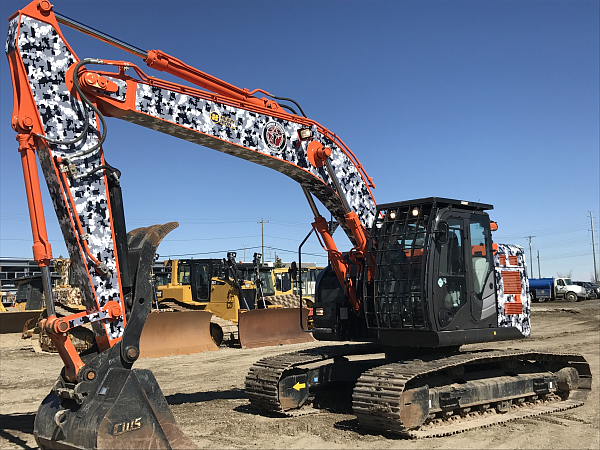
Excavators are usually the first call. Mini units in the 1 to 6 ton range handle residential and utility work without tearing up everything around them, while the 20 to 45 ton class is what commercial and civil projects actually need. Good used units run between $80,000 and $200,000. The hours on the machine tell you more than the price does.
- Mini excavators: best for residential, utility, and confined site work
- Standard excavators: suited for commercial, civil, and heavy earthworks
- Always check hours and undercarriage condition before buying used
Wheel Loaders move material faster than most other options on a busy site. Compact used loaders start around $60,000, and larger production machines can reach $150,000 to $400,000.
- Compact loaders: good for site cleanup, aggregate handling, and lighter applications
- Production loaders: built for high-volume, high-cycle operations
- Inspect the hydraulic system carefully before committing; that’s where issues tend to hide
Skid Steers are what a lot of contractors wish they’d added to their fleet earlier. Tight spaces, multiple attachments, genuine versatility. Used models sit between $25,000 and $60,000.
- Works in spaces that larger machines simply cannot access
- Compatible with a wide range of attachments, buckets, augers, sweepers, and more
- Often, the most practical first buy is when building a fleet from scratch
Dozers handle the work that everything else depends on, but nobody really notices or talks about them. Clearing, pushing, rough grading. Smaller units, around 80 to 100 horsepower, start at roughly $100,000 used. Larger production dozers cross $500,000.
- Smaller dozers: suited for land clearing, site prep, and lighter grading
- Larger dozers: built for bulk earthworks and high-production environments
- The capability gap between sizes is just as wide as the price gap
Motor Graders are precision machines doing precision work. A finished road surface or graded pad that needs to hit specific tolerances requires a grader, not a dozer. Used units from dependable brands start around $150,000 and climb past $300,000 for newer models.
- Critical for road construction, maintenance, and final grade work
- Not interchangeable with dozers, despite what tight budgets might suggest
- Blade condition and circle drive health are key inspection points on used units
Off-Highway Trucks are a large investment, but on projects that move serious volumes of material, the math works out. Budget somewhere between $200,000 and $500,000, depending on capacity and condition.
- Best suited for mining, quarrying, and large-scale earthworks
- Site terrain should influence your size decision as much as volume does
- High utilization is what makes ownership financially justifiable
Compactors are the machines people under-budget for until the ground underneath a finished surface tells them otherwise. Poor compaction on a road base or building pad is not a cheap problem to fix after the fact.
- Soil compactors for earthworks, pad construction, and trench backfill
- Asphalt compactors for road and pavement finishing work
- Skipping proper compaction equipment to save upfront costs rarely holds up
Articulated Trucks exist for the sites that would defeat anything else. Soft ground, steep grades, and remote access roads across northern Alberta projects. Where a standard haul truck gets stuck or damaged, an articulated truck keeps working.
- Designed specifically for off-road and rough terrain haulage
- Common on resource, forestry, and remote civil projects across Alberta
- All-wheel drive and articulated steering make them reliable in the worst conditions
Heavy Equipment Attachments are worth thinking about before you choose the base machine, not after. The right hydraulic hammer, auger, or grapple paired with what you already own can do the job of an entirely separate unit. When looking at heavy equipment for sale in Alberta, always ask about attachment compatibility upfront.
- Hydraulic hammers for demolition and rock breaking
- Augers for drilling, post setting, and foundation work
- Grapples and thumbs for material handling and sorting
Miscellaneous Equipment rarely gets its own line in a budget conversation, but its absence is felt immediately when a night shift can’t see or when dust is shutting a site down. Heavy equipment rentals in Alberta make practical sense here because these are units you need on-site without needing to own them long-term.
- Water trucks for dust suppression and site compliance
- Light towers for night operations and low visibility conditions
- Service trucks for field maintenance and keeping the primary fleet running
Heavy Iron carries all of it. Excavators, dozers, graders, compactors, attachments, and everything in between for sales and rentals, ready to work. Twenty years in Alberta means we’ve seen every job type and we know what actually gets the work done. You won’t get a blank stare when you call us about a specific machine for a specific job. That’s not how we operate.
Should You Buy New or Old?
New equipment gets you a manufacturer’s warranty, usually somewhere between one and three years, along with the latest fuel efficiency, predictable maintenance from day one, and better financing rates. If you want the machine built to a specific configuration, new is also your only real option. There’s genuine value in that, depending on where you are and what you’re running.
But used is where most contractors find their footing, and for good reason. You’re typically looking at 30 to 50 percent less than new, lower insurance costs, no first-year depreciation hit, and a machine that’s already proven itself in real conditions. You know what it is. A new machine is still a promise.
The sweet spot in the used market is under 5,000 hours from a brand that holds up that tier. A machine in that range has done real work but has plenty left in it. What you want alongside those hours is a complete service history. No records means no way to know how it was treated, and that’s a risk not worth taking, regardless of how good the price looks on the website of heavy equipment for sale in Alberta.
Where to Buy/Rent Construction Equipment in Canada
Finding equipment isn’t the hard part. Finding a heavy equipment agency in Alberta that understands what your project actually needs and backs it up with proper service is where most contractors run into trouble.
Heavy Iron Inc. has spent over two decades building a reputation across Alberta for exactly that. Whether you’re purchasing or renting, here’s what sets them apart:
- Fleet of 120 plus machines ready to deploy across a wide range of project types
- Equipment sourced from proven manufacturers that hold up in Alberta’s demanding conditions
- Sales inventory that goes beyond just the machine, attachments included
- A team with real field knowledge, not just a sales script
- Transparent process, whether you’re a first-time buyer or expanding an existing fleet
If you want to browse what’s available for heavy equipment rentals or sales in Alberta or have a conversation about what fits your operation, head to Heavy Iron Inc.’s sales and rentals inventory.
The Pre-Purchase Inspection Checklist: Things to Verify
Nobody talks about the deals that went wrong. The excavator that looked fine on a video call arrived with a blown hydraulic pump. The dozer had 6,000 hours on the clock, but wear patterns that told a completely different story. It happens more than people admit, and it almost always comes down to skipping a proper inspection.
Here’s what to check before you buy from any heavy equipment agency in Alberta:
Hours vs. actual condition.
The hour meter is a starting point, not the full picture. Check the pedals, seat, and controls because they tell you how hard a machine actually worked, regardless of what the meter says. Ask for service records, and if the seller cannot produce them, factor that into your offer or walk away.
Start it cold. Always.
A warm engine hides a lot. Listen for knocking, watch the exhaust, and check the coolant. Milky coolant means water in the system, and that is not a minor fix.
Hydraulics.
Operate every function fully: bucket, boom, stick, blade, everything. Slow or jerky response and leaks around hoses and cylinders are worth taking seriously, even when they are presented as small issues.
Undercarriage on tracked machines.
This is the most expensive wear item on the machine, and the one sellers are most likely to gloss over. Check the sprockets, rollers, and track links and get a wear estimate before you agree on a price.
Frame and structure.
Fresh welds and new paint in odd places are worth questioning. Cracks around the boom or frame joints and excessive play in the attachment pins point to how a machine was used and whether it was used carefully.
The cab.
A destroyed interior usually reflects how the whole machine was treated. Test every gauge and warning light and check that safety features are working. If the basics were ignored, assume everything else was too.
When in doubt, pay for an independent inspection. It costs far less than the repairs you will be dealing with if you skip it.
Conclusion
Heavy equipment decisions in Alberta are not something you figure out as you go. The wrong machine on the wrong job, a purchase made without a proper inspection, or a rental sourced from someone who does not understand your timeline all have a way of showing up in your project costs and your stress levels at the same time.
What this guide comes down to is pretty straightforward. Know your market, understand what each machine actually does, inspect before you buy, and work with people who have been doing this long enough to give you honest answers rather than just closing a deal.
If you are at the point where you need heavy equipment for sale in Alberta or are looking at heavy equipment rentals in Alberta for an upcoming project, Heavy Iron Inc. has been helping contractors across Canada make the right call for over 20 years. The fleet is there, the inventory is real, and the team knows what they are talking about.
Head to Heavy Iron Inc. and browse what is available. Getting the right machine on your job site starts with talking to the right people.
Frequently Asked Questions (FAQs)
1. Is it better to buy or rent heavy equipment in Alberta?
If utilization is high and the work is consistent, buy. If the machine sits between projects, rent.
2. What should I look for when buying used heavy equipment in Canada?
Service records, engine condition, hydraulics, undercarriage, and frame. When in doubt, get an independent inspection.
3. How much does used heavy equipment cost in Alberta?
Anywhere from $25,000 for a skid steer to over $500,000 for a production dozer. Hours and conditions drive the price as much as the brand.
4. What types of equipment does Heavy Iron Inc. rent out?
Excavators, dozers, motor graders, wheel loaders, rock trucks, and more. Fleet ranges from 5 ton to 90 ton machines.
5. Does Heavy Iron Inc. serve contractors outside Alberta?
Yes, they serve customers across Canada and the United States.